 ultimate-guide
Epoxy Floor Coating Installation Cost: 2026 Pricing Guide
Table of Contents
- What Actually Drives Epoxy Floor Coating Cost
- Concrete Surface Preparation for Epoxy: The Step That Decides the Price
- Epoxy Floor Installation Process, Step by Step
- DIY Epoxy Kit vs Professional Installation: Where the Money Goes
- Epoxy vs Polyaspartic Cost: Which System Fits Your Budget and Timeline
- Long-Term ROI: What the Floor Costs You Over Its Service Life
- Frequently Asked Questions
Last Updated: September 16, 2026
What Actually Drives Epoxy Floor Coating Cost
Epoxy floor coating installation cost is not a single number. It is the sum of four variables: slab size, surface preparation needs, coating system, and applicator.
Square Footage and Garage Size
A standard two-car garage runs roughly 400 to 500 square feet; a single-car garage lands closer to 250 to 300 square feet, and a three-car garage can exceed 700 square feet. Square footage multiplies every other cost driver.
Material Costs vs. Labor Costs
Material and labor are the two halves of every quote. Materials include resin, hardener, primer, topcoat, and any flake or decorative additive; labor covers grinding, crack repair, moisture mitigation, application, and curing.
Concrete Surface Preparation for Epoxy: The Step That Decides the Price
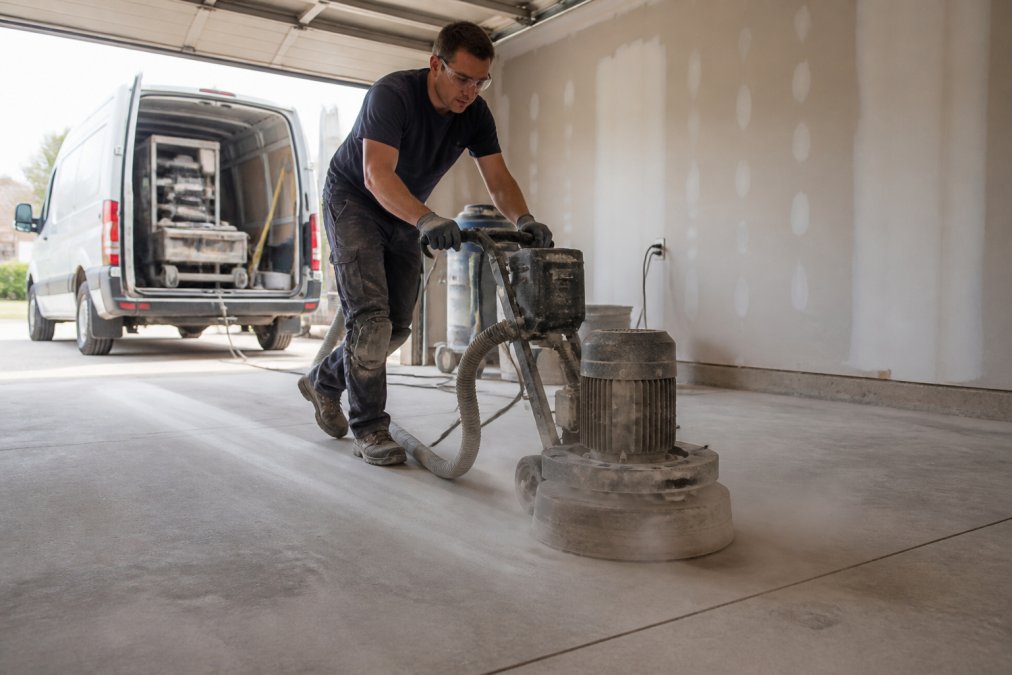
Surface preparation is the single largest swing factor in epoxy floor coating installation cost. A clean, dry, sound slab needs minimal work; one with oil stains, spalling, or a failing sealer needs diamond grinding, patching, and possibly a moisture vapor barrier first.
Why Moisture Testing and Damage Inspection Change the Quote
Moisture is the silent killer of epoxy floors. Concrete releases water vapor from below, and if that pressure builds under a coating that cannot breathe, the floor blisters and lifts. A responsible contractor tests before quoting.
Epoxy Floor Installation Process, Step by Step
The installation process follows a fixed sequence, and each phase has its own curing time. Knowing the order helps you plan downtime, especially for a working shop or retail space.
- Site assessment and moisture testing. Confirm the slab is a candidate and identify repairs.
- Surface preparation. Diamond grinding, crack repair, and oil stain treatment.
- Primer or moisture vapor barrier. Seals the substrate and promotes adhesion.
- Base coat application. The main resin layer, rolled or squeegeed across the slab.
- Flake broadcast (optional). Decorative flakes are scattered while the base is wet.
- Topcoat. The protective clear layer that carries slip resistance and chemical resistance.
- Cure. Full cure before heavy traffic or vehicle parking.
How Long Each Phase Takes and What It Means for Your Business
A typical residential garage takes two to three days from grind to final topcoat, plus curing time before parking. Commercial and industrial floors run longer due to square footage and sectioned work.
| Phase | Typical Duration | What It Affects |
|---|---|---|
| Surface prep and grinding | 1 day | Bond strength, long-term durability |
| Moisture barrier and primer | Same day to next day | Prevents blistering and peeling |
| Base coat and flake broadcast | 1 day | Aesthetic finish, impact resistance |
| Topcoat and cure | 1 day plus cure window | Chemical resistance, service life |
DIY Epoxy Kit vs Professional Installation: Where the Money Goes
DIY epoxy kits cost less upfront and more over time. A big-box kit gives you resin, hardener, and basic tools, not a diamond grinder, a moisture test, or a warranty. When the floor peels after the first winter, you own the problem.
What a Professional Quote Should Itemize
A trustworthy quote breaks the work into visible line items. If yours arrives as one lump sum, ask for the breakdown. This checklist maps directly to where the money goes.
- Square footage and measured slab area
- Surface preparation method (grinding vs. etching) and extent
- Crack, spall, and oil stain repair scope
- Moisture test results and whether a vapor barrier is included
- Coating system name, number of coats, and topcoat type
- Flake or decorative finish selection
- Curing and return-to-service timeline
- Warranty terms and who is responsible for failures
- Licensing and insurance confirmation
Where the Money Actually Goes in a Professional Quote
Most homeowners assume the resin is the expensive line. It is not. Across the quotes a homeowner is likely to collect, the split typically lands near this shape:
| Line item | Share of a typical quote | What drives it up |
|---|---|---|
| Surface preparation (grinding, crack repair, oil treatment) | Largest single line | Slab condition, contamination, square footage |
| Moisture mitigation (vapor barrier primer) | Small to moderate | High moisture readings from a calcium chloride or RH probe test |
| Materials (primer, base resin, flake, topcoat) | Moderate | System choice: standard epoxy vs. polyaspartic topcoat |
| Labor and application | Large | Number of coats, phasing around business hours, site access |
| Mobilization, equipment, disposal | Small | Distance, dust containment, haul-away of grinding residue |
Regional Labor Rate Variance
National averages hide the biggest swing in the labor line. A dense-metro crew carries higher overhead, insurance, fuel, shop rent, wages, than a rural one, and that shows up in the hourly rate. The same 500-square-foot garage lands at meaningfully different totals in a high-cost coastal metro, a mid-size inland city, or a rural county.
Epoxy vs Polyaspartic Cost: Which System Fits Your Budget and Timeline
The epoxy vs polyaspartic cost comparison comes down to cure speed and UV stability. Epoxy cures slowly, takes days to return to service, and can yellow under sunlight. Polyaspartic and polyurea cure in hours, resist UV yellowing, and handle hot tire pickup far better.
| System | Cure Speed | UV Stability | Best For |
|---|---|---|---|
| Epoxy | Slow | Can yellow | Interior, budget-focused slabs |
| Polyaspartic | Fast | Resists yellowing | Sun-exposed, fast-turnaround floors |
| Epoxy base + polyaspartic top | Moderate | Resists yellowing | Best balance of cost and service life |
Long-Term ROI: What the Floor Costs You Over Its Service Life
The cheapest quote is rarely the cheapest floor. A properly prepared slab delivers years of service with minimal maintenance, while a poorly bonded floor fails early and forces full removal and re-coat, costing more than doing it right the first time. The reason is almost always the same: moisture never tested, or prep never scoped.
The Cost-Per-Year Calculation, Worked Out
ROI on a floor is a division problem: take the total installed cost, divide by expected service life in years, and you have the annual cost of ownership. Compare that number across bids instead of the sticker price.
| Scenario | What you pay for | What you get |
|---|---|---|
| Low bid, minimal prep, no moisture test | One application | Short service life; likely full removal and re-coat |
| Proper prep, moisture mitigation included | One application done correctly | Long service life; maintenance only |
| Failed floor, then re-do | Two applications, two preps, disposal, downtime | Same result as doing it right once, at higher total cost |
Why Moisture Mitigation Is the ROI Decider
Moisture is the most common reason a coated floor fails early, and the line item most often missing from a low bid. Concrete releases water vapor from below; if that pressure builds under a coating that cannot breathe, the floor blisters and lifts, sometimes within the first season.
Maintenance and Longevity Expectations
Maintenance costs stay low on a sound coating: routine sweeping, occasional damp mopping, and prompt spill cleanup. Chemical and impact resistance mean an auto shop floor survives oil drips and dropped tools without staining or chipping, that durability is the return.
Frequently Asked Questions
How much does it cost to epoxy 1,000 square feet?
There is no single number, because epoxy floor coating cost depends on your concrete's condition, the coating system you choose, and labor rates in your area. A 1,000 square foot job with heavy cracking, oil saturation, or moisture problems costs more than a clean, sound slab because grinding, patching, and primer add steps. The only reliable figure for your space comes from an on-site estimate that includes surface preparation and materials.
What is the downside of epoxy flooring?
Epoxy is hard and durable, but it is not indestructible. Hot tires can pull up poorly bonded coating, UV exposure yellows standard epoxy, and a floor applied over damp concrete can blister or peel within a season or two. It is also slippery when wet unless a slip-resistant additive is broadcast into the topcoat. Most failures trace back to skipped surface preparation, not the resin itself.
Is it cheaper to tile or epoxy a floor?
For large open areas like garages and shops, epoxy usually costs less per square foot than tile because there are fewer materials and no grout lines to maintain. Tile wins on repairability: you can replace one cracked tile, while a damaged epoxy floor requires recoating a section. For small rooms or spaces where you want a specific tile look, tile can be competitive.
Does epoxy flooring increase home value?
A clean, professionally applied coating improves how a garage or shop shows during a sale, and buyers in the Central Valley often treat a finished floor as a signal of a well-maintained property. It is not a guaranteed dollar-for-dollar return like a kitchen remodel. The bigger financial argument is avoided repair costs: a coated slab resists stains, spalling, and chemical damage that would otherwise need patching.
How long does professional epoxy floor installation take?
Most residential garage projects run two to three days from grinding to final topcoat, with foot traffic allowed after 24 hours and vehicles after roughly 72 hours. Commercial and industrial jobs are often phased so part of the space stays open. Polyaspartic systems shorten the timeline because each coat cures faster, which matters if you cannot afford to close a retail or service area for long.
Why do some epoxy floors peel after the first winter?
Peeling almost always comes from moisture or contamination under the coating. Concrete releases water vapor from below, and if the slab has no moisture vapor barrier and no testing was done, that vapor pushes the coating off from underneath. DIY kits skip diamond grinding and moisture testing, so the resin bonds to a weak, dusty surface instead of the concrete substrate. Professional application addresses both before any base coat goes down.
The real challenge with epoxy floor coating installation cost is that the number depends entirely on your slab, and no two slabs are the same. Valley Floor Coatings provides professional epoxy floor coatings for residential, commercial, and industrial clients, backed by licensed and insured workmanship and a free estimate that itemizes every step before work begins. Get started with Valley Floor Coatings and get a floor that holds up to oil, traffic, and time.